Posted on

Overcoming Obstacles: Carina Comer’s Bakery Journey

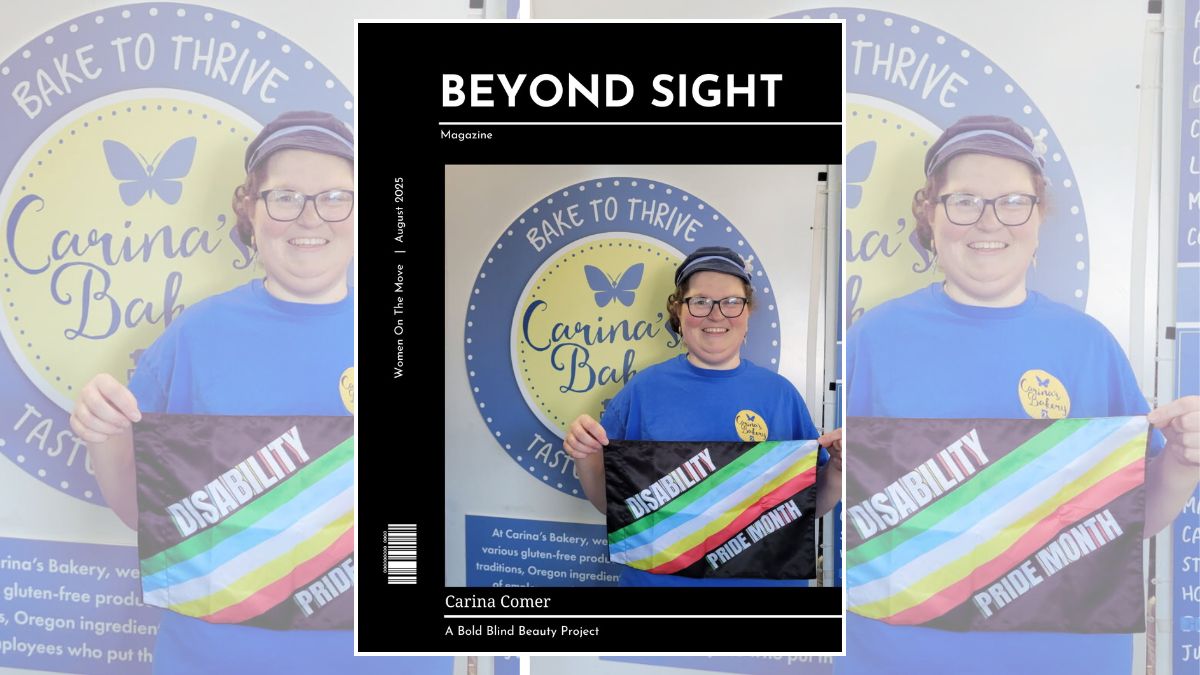
The header, the Beyond Sight Magazine cover, and the YouTube Thumbnail include a Portrait-style photograph (featured in the Beyond Sight Magazine cover template). It shows an image of Carina standing in front of a backdrop of a large circular logo for 'Carina's Bakery,' which is highlighted with a butterfly design, symbolizing transformation and growth. The logo is surrounded by a pale blue circle, creating a soft contrast against the overall warm and inviting atmosphere of the bakery setting. Carina is dressed in a bright blue shirt, which conveys a sense of vibrancy and friendliness. She is holding up a Disability Pride flag that has bold stripes of black, white, green, yellow, blue, and red. The image is styled as a magazine cover, titled ‘BEYOND SIGHT | A Bold Blind Beauty Project,’ and features Carina Comer. The cover is dated August 2025.

Along the way, I got to learn family traditions and hear stories from my past. And I got to figure out how I could create and express myself through my baking.

~Carina Comer

Editor’s Note

Carina Comer, wearing a bright blue chef's jacket, smiles while holding a clapperboard for a documentary titled 'Legacy Makers'. The background features stage lights and a film reel design with the text 'NEW DOCUMENTARY TV SHOW COMING IN 2025' prominently displayed.

This month, Bold Blind Beauty’s Woman On The Move is Carina Comer, a powerhouse of determination, creativity, and heart. From battling cancer as an infant to navigating vision loss, workplace barriers, and the often cutthroat culinary world, Carina has faced challenge after challenge and turned each one into an opportunity to build something extraordinary.

Rooted in her Scandinavian heritage and fueled by a vegan lifestyle, Carina’s bakery is more than a place for delicious treats; it’s a haven where people of all abilities can feel safe, valued, and free to express who they truly are. Her journey is a testament to grit, perseverance, and the belief that when doors close, you can create your own.

As Carina says, baking has been her way to create, connect, and give back, from beachside bake sales for cancer patients to running a thriving business that uplifts others with disabilities. She reminds us that living boldly means embracing your values, owning your story, and making space for others to shine alongside you.

Stephanae McCoy
Editor-in-Chief, Bold Blind Beauty

Beyond Sight Magazine Cover

Cover image of Beyond Sight Magazine featuring Carina Comer, who is smiling and holding a flag that reads 'DISABILITY PRIDE MONTH.' She is wearing a blue shirt and stands in front of a large sign with the Carina's Bakery logo.
Beyond Sight Magazine |  Carina Comer

YouTube Video

August Woman On The Move | Carina Comer

Introduction and Background

Hi. I’m Carina here with my guide dog, Moby. Hi Moby.

I am 33, and I am legally blind due to an astrocytoma (cancerous brain tumor) I had as an infant. And as a result of that, I have tunnel vision in one eye, no vision at all, and no light perception in the other eye. The nerves were severed by the tumor, and it also caused hormonal loss in the pituitary and other long-lasting health effects.

Family Background and Values

But I grew up in a very determined, humble, well-grounded, and entrepreneurial family with lots of values. Both my grandfathers came from Sweden and Ireland, and worked their way up through the military, through odd jobs, until they both opened their own businesses in Connecticut, where I’m originally from.

So it was just natural to have that determination to carry forward no matter what happened. Even when the tumor relapsed and I had to go get radiation treatment, I made an adventure out of it, and it was exhausting, but it shaped who I am today and shaped what I would do in terms of philanthropy and how I viewed the world.

School Experience and Early Challenges

Also, what shaped me is the fact that I went to a public school, and I had aids that would help me get large print, help me get around, which both, you know, put a target on my back for being special. But also made it so I had to, you know, figure out how to navigate in the normal world without a cane ’cause my parents didn’t know what that was until I was 16, and the blind commission basically there, you know, suggested it.

But I managed even without a whole lot of self-confidence, and I buried myself in school, in the work itself, not to have to deal with the social situation of how kids thought of me differently and not worthy of their interaction.

I connected with adults, and I especially connected to the feelings I got when in the kitchen with my mom. I could forget about all the crazy diets and health regimens I was on and feel the calming nature that kneading dough has. And get a little taste of sweetness and be able to share that with others in a way that I couldn’t at that time express myself.

Discovering Baking and Philanthropy

Along the way, I got to learn family traditions and hear stories from my past. And I got to figure out how I could create and express myself through my baking. Eventually turned into a philanthropic bake sale that would last all summer. I would take it to the tricycle to sell at the beach and raise money for cancer patients. I figured out a way to make it happen. When I started crashing the tricycle later on because I was losing vision again, I stumbled through it, and eventually, that’s what led me to getting a guide dog.

Culinary School Journey

Meanwhile, I met people who really encouraged the culinary side of me and encouraged me to go to pastry school at Johnson Wales. It was an eye-opening look into how cutthroat the industry is. Sure, on paper, I had accommodations, and I would get large print textbooks and audiobooks when possible.

Although it was not easy, I had to do a lot of that work myself. But when it came to making a cake in three hours that looked amazing, there was no accommodation. And there was no getting the teacher, or at least I didn’t know how, to ask the teacher to show me again in private. Never mind the fact that kids would look at me sideways when I’d be standing there at the end, and when it was cleaning time, and I wouldn’t know what to do ’cause I felt like I was just in the way if I tried to go get something, or I was too slow.

Challenges like that continued as I tried to find internships and then find work, and I had to settle for more free internships instead. Or found work but still felt like I was being targeted. So I went to grad school, moved out to Oregon, I fell in love with its foodie scene and its transportation and acceptance.

Career Challenges and Starting Own Business

But even after going to grad school here, I still have the door upon door shut in my face. An interview would go great, and then I’d pull out my cane at the end to get out of the interview room and make my way safely home. And you could see the air change, and you could feel the disappointment, and I would never hear from them again.

So I had to go my own way. I turned what had been a side business, a hobby, selling big goods at a farmer’s market and renting out a way too expensive commissary kitchen that also didn’t know how to accommodate a person with disability. And I opened my own business that celebrates my Scandinavian roots, my vegan lifestyle, and creates a place where not only I feel safe, but my employees with all kinds of disabilities feel safe as well and can express who we truly are. Thank you.

Carina’s Bio

Carina is a cancer survivor from Connecticut who always knew she wanted to be a baker. Despite being severely vision impaired, she attended pastry school and many hard-won steps in her career took her to Oregon and eventually opened a bakery celebrating her Scandinavian roots and vegan lifestyle while making a way for people with disABILITIES to have gainful employment and a place in their community. 

Connecting With Carina Comer

Connecting With Bold Blind Beauty

Image descriptions:

  • The header, the Beyond Sight Magazine cover, and the YouTube Thumbnail include a Portrait-style photograph (featured in the Beyond Sight Magazine cover template). It shows an image of Carina standing in front of a backdrop of a large circular logo for ‘Carina’s Bakery,’ which is highlighted with a butterfly design, symbolizing transformation and growth. The logo is surrounded by a pale blue circle, creating a soft contrast against the overall warm and inviting atmosphere of the bakery setting. Carina is dressed in a bright blue shirt, which conveys a sense of vibrancy and friendliness. She is holding up a Disability Pride flag that has bold stripes of black, white, green, yellow, blue, and red. The image is styled as a magazine cover, titled ‘BEYOND SIGHT | A Bold Blind Beauty Project,’ and features Carina Comer. The cover is dated August 2025.
  • Carina Comer, wearing a bright blue chef’s jacket, smiles while holding a clapperboard for a documentary titled ‘Legacy Makers’. The background features stage lights and a film reel design with the text ‘NEW DOCUMENTARY TV SHOW COMING IN 2025’ prominently displayed.
  • Video Description: Carina is a woman with fair skin and reddish cheeks. She wears square, black-rimmed glasses and has wavy, reddish-brown hair. She is wearing a blue shirt and blue earrings.
  • A 5-panel grid of Carina’s Bakery assorted baked goods.

Posted on

 Defying Norms: Jessica Gonzalez’ Triumphs In Education & Blind Tennis

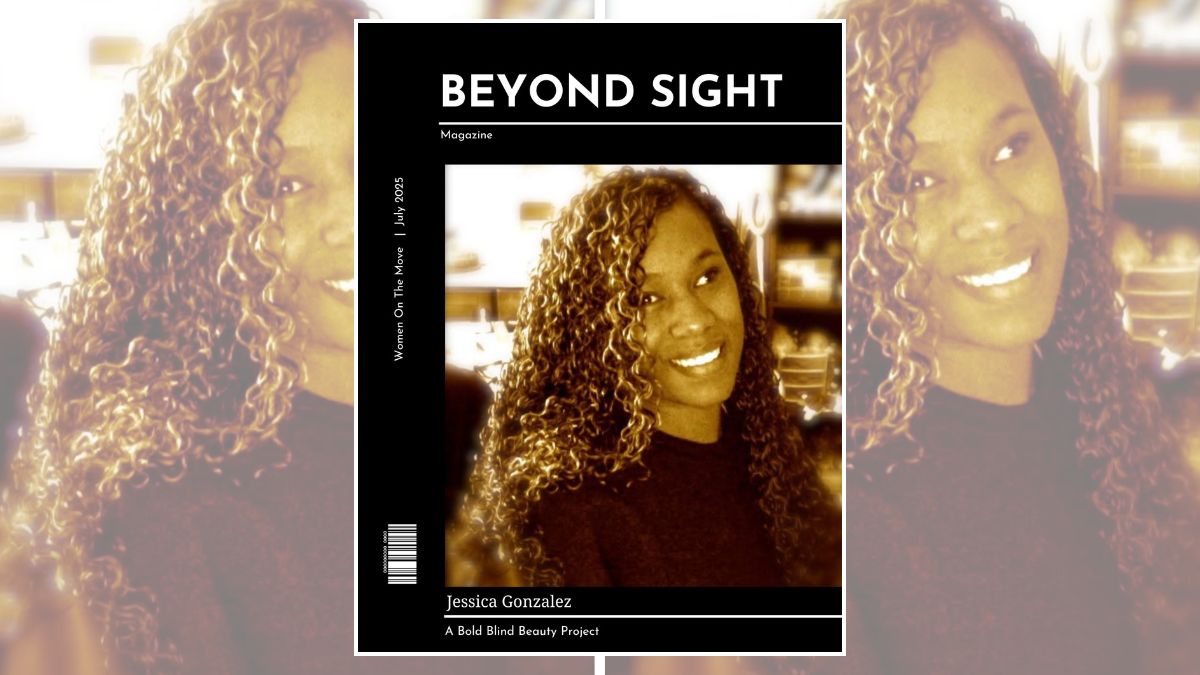
The header photo is in the Beyond Sight Magazine cover template and shows an image of Jessica with long, curly hair that extends down past her shoulders. The hair is voluminous and tightly curled. She is wearing a dark-colored top. The background appears to be an indoor setting with shelves and various items, but the details are not discernible. The image is styled as a magazine cover with the title ‘BEYOND SIGHT | A Bold Blind Beauty Project’ and features ‘Jessica Gonzalez'. The cover is dated July 2025.

I would like to make sure that the people out there hear me when I say, go out there and try something new. Even if it’s baby steps to get out there and try little stuff. Don’t be afraid, ’cause if I were afraid, I wouldn’t be where I am today.

~Jessica Gonzalez

Editor’s Note

We are so excited to introduce you to our Woman On The Move for July: Jessica Gonzalez!

Jessica’s story begins with heartfelt gratitude, as she expresses her thanks to Bold Blind Beauty for this feature and gives a special shout-out to her friend Melody. Get ready to be empowered by Jessica’s incredible journey of perseverance and self-advocacy. She faced significant vision challenges from an early age, navigating a world that wasn’t always understanding.

Through it all, Jessica found her path to independence, embracing her unique perspective and bravely stepping outside of societal expectations. Her experiences led her to remarkable achievements, from surprising career choices to discovering a passion that’s taking her across the globe.

Jessica’s message is a powerful reminder of the impact of encouragement and the importance of supporting one another, no matter how big or small the stride. She truly embodies what it means to be “on the move.”

Join us in celebrating Jessica Gonzalez, a remarkable woman whose journey lights the way for others to embrace their challenges and pursue their dreams.

Stephanae McCoy
Editor-in-Chief, Bold Blind Beauty

Beyond Sight Magazine Cover

A magazine cover titled 'BEYOND SIGHT' featuring a sepia-toned portrait of Jessica Gonzalez with curly hair. She is smiling, and the cover highlights 'Women On The Move' and 'A Bold Blind Beauty Project'.
Beyond Sight Magazine |  Jessica Gonzalez

YouTube Video

Introduction and Gratitude

Hi guys. My name is Jessica Gonzalez, and I would like to start off by saying thank you to Bold Blind Beauty for featuring me in this month’s magazine. Thank you. I like to give a shout-out to my friend Melody for telling me all about this. Thank you, girl. Love you.

Early Life and Vision Challenges

So let’s get started. My name is Jessica Gonzalez, and I was born four months early as a premature. I was diagnosed with the eye disease, retinopathy of prematurity, which is short for ROP. And in my state, my vision, I don’t know how others’ ROP is, but my vision may be a little different from others. I am totally blind in my left eye, and in my right eye, I have no peripheral vision, and I have very cloudy vision in my right eye, which is like looking through the fog, and it’s like being nearsighted and farsighted, kind of, at once.

And so with that, as a child, I hid that from the world, I mean obviously you can see that one eye is straight and one eye is crooked. And so that always brought a lot of stares, a lot of teasing. But I still walked with no cane, and I had no guide dog, and I had no help. And oh boy, falling down was a thing to do.

And I still got teased a lot by a lot of peers growing up. But as I’ve gotten older and a lot more confident in my life, a lot of that stuff stopped. I don’t know if people became more mature, but I definitely became more confident, and I learned to embrace my vision and roll with the punches.

Gaining Independence and Confidence

The image shows a person wearing a dark quilted vest and a short-sleeved shirt, positioned closely next to a large dog. The dog has light fur and is wearing a collar with a leash attached. The dog is panting, with its tongue visible. In the background, there are several trees with green foliage and a building with a brick facade. The building has a distinct architectural feature, an archway, and is situated at a distance behind the person and the dog. The scene appears to be outdoors, with a clear sky visible above.

So, how I did that was I started off by going to the Orientation Center for the Blind in Albany, California. That is where I first learned how to read and write braille. I learned my orientation skills. I learned how to use the computer as well as my living skills, which pretty much kind of highlights, you know, how to get around the house, how to organize your stuff, and how to cook and clean.

After I finished that program, I went and got my very first guide dog, Fender. And I learned from there how to be severely independent. I started feeling more confident in my life. I started feeling safer knowing that I have a guide dog next to me. I. And learning that my independence can now be strided off and a little bit more smoothly, and I was less afraid now that I had a cutie pie next to me. So once I got him and finished the school for Guide Dogs, I moved down to Sacramento, and then I ended up going to school.

Pursuing a Career in Film

And this was another portion of my visual journey that really, really tested my faith in my own self and my vision. It was definitely, it was a major that I went into called digital film and video production, which a lot of people told me not to do. It was very visual, and that is something that I should just leave to the sighted people, and I was told to go and do something that’s more for you. And I would tell people, okay, well, what is that?

Filling out paperwork, typing people’s papers, working at a front desk, like, you know, what do you suggest? And of course, that was what they thought that we all blind people should be doing. But I did not wanna do that. I wanted to do something outside the norm. I didn’t wanna do the stereotypical, what blind people are supposed to do.

So I went to school anyway, and I graduated with a 3.9 GPA and did a killer speech at the end, and it was a struggle. I did struggle a little. I could not see through the camera lens. I can see it once it was done, and it was on a big, big, big screen. But I had a lot of help. And thank you for all my filmmakers out there who guided me along the way and helped me be who I am today. Thank you. And so instead of looking through the camera, I would direct someone else to look through the camera because I know what I wanted it to look like, but I just needed a little assistance to help make that happen. So that’s how I was able to get through film school and graduate with honors.

Working at Apple

The image shows a person with long, wavy hair that extends past the shoulders. The hair appears to be dark in color. The individual is wearing a zippered garment, possibly a jacket or sweater, with the zipper partially visible at the neckline. In the background, there is a shelving unit with various items, including rolled-up materials or objects that resemble yarn or fabric. The shelves are positioned to the right side of the image. On the left side, there are horizontal lines that suggest the presence of blinds or a window covering.

And so after I was done with that, I went to apply for a job at Apple, and I started off as a technician, and I was kind of skeptical at first ’cause I was like, oh my God, they’re not gonna hire me. I’ve been down this route before, where they were like, Why would we wanna hire you? What can you do for us? What would make you, what would make us wanna hire you before we hire anyone else? And I just pushed through it, and I was like, look, don’t not hire me because I’m blind. You need to see what I can do first. And I let that just flow with it, and I said, you know what, I’m gonna just hope for the best.

And sure enough, I was able to land the job. And four years later, I got hired on with Apple Inc. And I was hired on as a logistics warehouse trainer, and that is where I reside today in my work field. And as I started working that job, that job was a little, it was, it was perfect for me, but I didn’t realize how much eyesight I would need or how much sight I would use.

And with me using the little bit of sight that I had left, I was stretching my limits. I was having to read a lot of papers, read a lot of instructions, and use the computer a lot. And I had to have the font big, and I had to have the brightness up really high. But overall, I was telling them, look guys, I think I need to go back and get a refresher on my braille and my computers and everything else because I feel now I am in a part of my life that will allow me to use these skills and I can actually put them to use.

So I was granted the time to go and learn these skills at the Society for the Blind, and I was able to relearn how to use braille and use my computer and how to get through my job nice and nice and successfully. So that is where I am in my job.

Discovering Blind Tennis

While I was at the Society for the Blind, I was introduced to blind tennis, and that is where my passion lies today. So I was introduced to blind tennis and I didn’t wanna do it, I didn’t wanna do typical blind sports, which is track and field, beep baseball, goal ball like that, just, I don’t know, it just wasn’t for me.

So when tennis came along, I was like, wow, how do I do this? And I get that question asked every day. How do you do this? And I said, you know, guys, I had the same question that you guys have. I also wanted to know how. So with my extremely happiness to learn and my willing to get out there and try something new, I got out there and I tried it and oh my God, I fell in love and that landed me a wild card spot to fly to Italy in 2024 to play in my very first World Championship tournament. Yay. Thank you.

And to this day, I have the support of the Gold River Sports Club, and I also have the help of some amazing tennis players and my coaches, and friends to get out there, and they’re supporting me. And we are building a blind tennis team. So if there’s anyone else out there in the United States who would love to learn how to play blind tennis, but you don’t have blind tennis in your area. This hit me up on Instagram or Facebook and or my contact information will probably be down in my information, and feel free to give me a call, and we’ll work something out.

Encouragement and Final Thoughts

And so, yeah, my life has revolved around my blindness my whole life. But I didn’t let it stop me. I may have started off letting it stop me, but in the end, I didn’t let it stop me. And I would like to make sure that the people out there hear me when I say, go out there and try something new. Even if it’s baby steps to get out there and try little stuff. Get out there and try. Don’t be afraid, ’cause if I were afraid, I wouldn’t be where I am today.

So I wanted to just say thank you, everyone, for supporting us, wonderful blind people out here, and encouraging us to get out there and try new stuff, and just being here to support us and being proud of us, because your little bit of encouragement really goes a long way. So I just wanted to tell everyone thank you, thank you, thank you, and have a wonderful, wonderful day. Thank you guys.

Connecting With Jessica Gonzalez

Connecting With Bold Blind Beauty

Like what you’ve read and want to chat about it? Join us in the Bold Blind Beauty Facebook group.

Image descriptions:

  • The header photo is in the Beyond Sight Magazine cover template and shows an image of Jessica with long, curly hair that extends down past her shoulders. The hair is voluminous and tightly curled. She is wearing a dark-colored top. The background appears to be an indoor setting with shelves and various items, but the details are not discernible. The image is styled as a magazine cover with the title ‘BEYOND SIGHT | A Bold Blind Beauty Project’ and features ‘Jessica Gonzalez.’ The cover is dated May 2025.
  • YouTube thumbnail and video description: The thumbnail features a sepia-toned image of Jessica with long, curly hair, set against a softly blurred indoor background. The photo is framed with a gold border on the left, while the right side displays bold white text on a black background, highlighting “JULY WOMEN ON THE MOVE” and the name “Jessica Gonzalez.” A large gold circle adds a modern touch to the design, emphasizing the celebratory focus on Jessica as the featured individual.
    • In the video, Jessica has long braids cascading over her left shoulder. She is wearing a dark graphic tee with dark pants while seated on a stylish red and cream sofa surrounded by complementary sofa pillows. Behind her are several large windows accessorized with cream colored Venetian blinds.
  • The image shows a person wearing a dark quilted vest and a short-sleeved shirt, positioned closely next to a large dog. The dog has light fur and is wearing a collar with a leash attached. The dog is panting, with its tongue visible. In the background, there are several trees with green foliage and a building with a brick facade. The building has a distinct architectural feature, an archway, and is situated at a distance behind the person and the dog. The scene appears to be outdoors, with a clear sky visible above.
  • The image shows a person with long, wavy hair that extends past the shoulders. The hair appears to be dark in color. The individual is wearing a zippered garment, possibly a jacket or sweater, with the zipper partially visible at the neckline. In the background, there is a shelving unit with various items, including rolled-up materials or objects that resemble yarn or fabric. The shelves are positioned to the right side of the image. On the left side, there are horizontal lines that suggest the presence of blinds or a window covering.
  • A tri-panel of tennis images
    • The image shows two individuals standing side by side on a brick pavement. The person on the left is holding a tennis racket with a red frame and white strings in their right hand. They are wearing a gray zip-up jacket with the word “FLEXDAY” printed on the left side of the chest, a black skirt, and white athletic shoes. Their left hand is giving a thumbs-up gesture. The person on the right is wearing a black zip-up jacket, also with “FLEXDAY” printed on the left side of the chest, gray pants, and black sneakers with white soles. Their right hand is also giving a thumbs-up gesture. Behind them is a banner advertising a tennis championship, with text indicating the event will take place in Lignano Sabbiadoro, Italy, from September 23 to 29, 2024. The background includes a green fence and trees.
    • The image depicts a group of six individuals positioned in front of a red curtain. Two individuals are kneeling in the front row, while four are standing behind them. The person on the left in the front row is wearing a dark tracksuit with light blue and white accents, along with a lanyard and badge around their neck. The individual on the right in the front row is dressed in a dark blue blazer over a light-colored shirt and jeans.
      • In the back row, the person on the far left is wearing a black jacket with “USTA” written on it, holding a white cane. Next to them, another individual is holding an American flag, wearing a dark jacket with a white collar. The third person in the back row is wearing a red jacket with “JACK FISHER” written on it, also with a lanyard and badge. The person on the far right is partially visible, standing next to a white flag with red markings.
      • The flags being held are positioned vertically, with the American flag on the left and another flag on the right. The individuals are arranged closely together, with the flags prominently displayed behind them.
    • The image depicts a person playing tennis on an indoor court. The individual is positioned centrally in the frame, standing on a blue tennis court surface with white boundary lines visible. The person is wearing a black sleeveless tennis dress with white trim and white athletic shoes. On their left wrist, they have a black wristband. The person is holding a tennis racket in their right hand, which is raised above their head, and a yellow tennis ball in their left hand, also raised above their head, suggesting they are about to serve. Behind the player, there is a black banner with white text and logos, including “Comune di Lignano Sabbiadoro,” “VISPORT,” and “EUROSPORT.” The background also features a green structure, possibly part of the indoor facility.
Posted on

Beyond Her Blur: Marie Elise’s Empowering Perspective

I believe that no matter how much more my vision will degenerate, I now have the trust in myself and the trust in my surroundings that I will be able to thrive in the future.

~Marie Elise | @beyondmyblur

Editor’s Note

With great pride, we spotlight Marie Elise as Bold Blind Beauty’s May Woman On The Move. Previously featured as our April Monthly Beauty, Marie Elise’s story is proof of the transformative power of advocacy, leadership, and lived experience in the disability community.

Through her immersive travel stories, Marie Elise invites us to experience the world beyond sight-capturing the sounds, scents, textures, and flavors of natural destinations. Her unique perspective inspires us to connect deeply with our surroundings and discover the richness of every place through all our senses.

Building on this, Marie Elise’s work demonstrates that advancing equity isn’t just about breaking down barriers, it’s about expanding what’s possible when we center diverse perspectives and lived experiences. Her dedication to authentic representation and her ability to inspire meaningful change shine as a guiding light for all striving to create a more inclusive world.

We are honored to share Marie Elise’s story and celebrate her impactful contributions to disability advocacy and beyond.

Stephanae McCoy
Editor-in-Chief, Bold Blind Beauty

Beyond Sight Magazine Cover

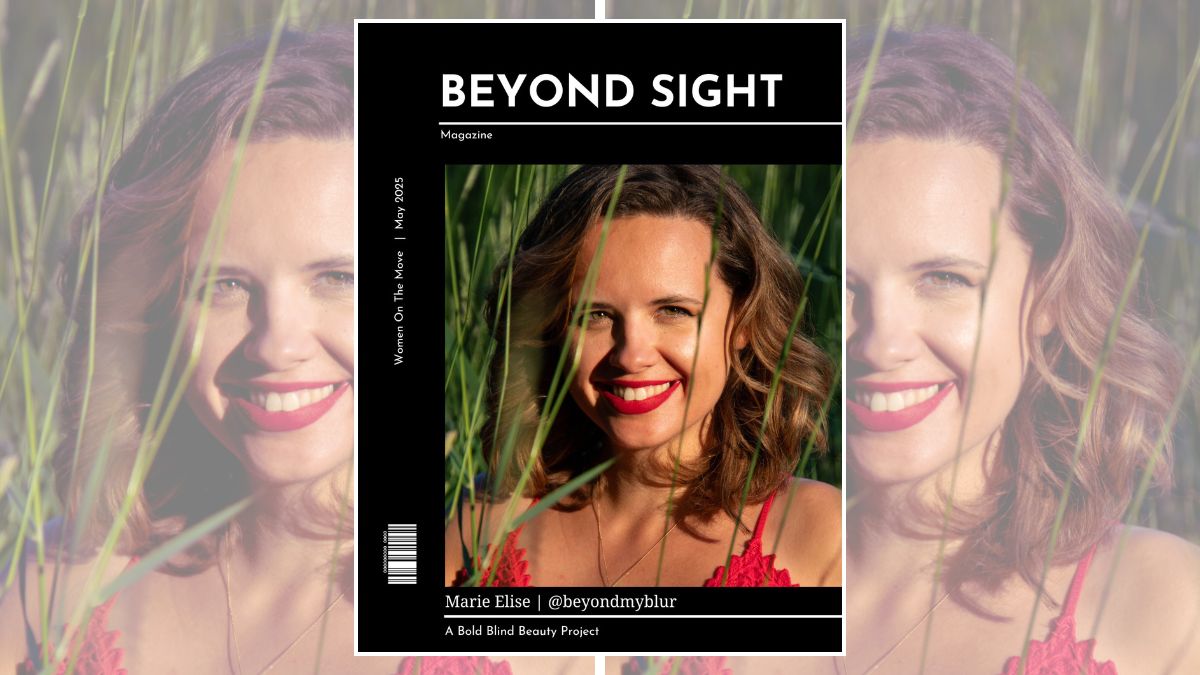
The photo is in the Beyond Sight Magazine cover template and shows a portrait of Marie Elise. She has wavy, shoulder-length brown hair and is
smiling brightly while sitting among tall green grass. She is wearing a vibrant
red lace top with thin straps and a delicate gold necklace featuring a small
charm. The sunlight casts a warm, golden glow on her face, highlighting her
skin, red lipstick, and cheerful expression. Some blades of grass are in the
foreground, slightly blurred, adding a natural and intimate atmosphere to the
image. The image is styled as a magazine cover with the title ‘BEYOND SIGHT | A Bold Blind Beauty Project’ and features ‘Marie Elise | @beyondmyblur.’ The cover is dated May 2025.
Beyond Sight Magazine | Marie Elise | @beyondmyblur

YouTube Video

Marie Elise | May 2025 Woman On The Move

Introduction and Gratitude

Hi everyone. Thank you so much for tuning in to this video. I am just beyond grateful and excited to be featured in this month’s segment of Women on the Move from Bold Blind Beauty, and will be sharing a bit more about my vision loss journey in this video. My name is Maria Elise. I’m 32 years old and I was born and raised in the Netherlands, which is also where I currently live.

I was diagnosed with Stargardt’s Disease, which is a subtype of juvenile macular degeneration, the genetic form of macular degeneration, when I was about 16 years old. This is, I think, about the average age to be diagnosed with Stargardt’s disease. The onset of the disease can vary a lot; some are diagnosed younger, already in their childhood, some, like me, uh, in puberty, and others, even in early adulthood.

Living with Stargardt’s Disease

Marie Elise is riding a white horse along a sandy beach with gentle waves rolling in behind her. She is smiling and wearing a riding helmet, dark
sunglasses, and a patterned black-and-white long-sleeve top with dark riding
pants. The sky is a vibrant mix of blue and white, filled with soft, wispy clouds.
The overall scene is bright, open, and joyful, capturing a serene moment by the
sea.
Marie Elise riding a white horse

Because of this condition, I am losing the central portion of my vision. So in the central part of my vision, I basically see a constantly moving blur with sort of like, I think it’s called visual noise in it. This kind of blur in the middle can get gray or black in the future, but I do not know when or how fast that is going to happen.

For me, my sight loss was quite rapid in the beginning. I think that I already started losing vision when I was maybe around 12 or 13, I just didn’t notice it. It’s because when I was diagnosed, I saw about 50% in my left eye and 30% in my right eye. Even though probably many of you with visual impairment will know that it is very difficult to sort of express what you see in percentages because my vision really varies depending on the lighting conditions, on how much color contrast there is, et cetera, et cetera.

Now I see between 10% to 15%, more or less, again, depending on the day. But I’ve had the luck that for at least the past couple of years, my vision has been relatively stable. So right now, I find myself in a phase where it’s stagnated.

My current vision allows me to navigate the streets without a white cane, as I still have enough functional vision left. But I do use an ID cane or symbol cane, especially when I’m traveling, to communicate to those around me that I have a visual impairment.

Coping with Anxiety and Building Trust

In the beginning, when I first got diagnosed, of course, I was still quite young that my brain took, as I like to call it, the dirtiest yet quickest escape route for me, which was flight.

I think that I suppressed my emotions concerning my visual condition for many years. I think that subconsciously, I was deeply anxious and truly afraid of what was going to happen to me in the future. And part of me still is, except now I have acknowledged that I have this anxiety. I have worked with it, and I have also grown a very steady and high level of trust for the future. As I really believe that no matter how much my vision will degenerate, I now have the trust in myself and the trust in my surroundings that I will be able to thrive in the future. And this doesn’t mean that the anxiety has gone away completely, but it just means that it is something that I can control and no longer overtake my life.

Because, unfortunately, when I was about 24 years old, having suppressed emotions for so many years, I suffered an anxiety disorder, and was in a really bad, bad place for the second half of my twenties. And I think this was my body’s way of saying, like, Hey, you know, I think that you’ve been suppressing a lot of emotions concerning your insecure future. And it’s time to, well, kind of look at it in the mirror, and that’s what I did. And here I am, in a place of more trust and love towards myself. So that was also really important for me to share with you in this video.

Creating a Travel Platform

Marie Elise, wearing a black polka dot dress and holding her symbol cane in her left hand, is smiling in front of the Mona Lisa painting in the Louvre. The only
thing separating her and the painting is an oval-shaped wooden bar. She is
standing in the designated disability space in front of the Mona Lisa.
The Mona Lisa

I think part of where the trust comes from is also that I now have my own platform. I am a very passionate traveler. I have always been, since I was a young child, I watched a lot of Steve Irwin, and I loved Planet Earth and listening to David  Attenborough, and all the nature documentaries. I’ve always been crazy about exploring. But of course, when you get told that you’re losing a very important part of your vision, I think there was also a part of me that was, that was really afraid that I could no longer do something that I was so passionate about.

So, being a passionate traveler, I actually started a travel platform for visually impaired travelers that is specifically, but not exclusively, as I like to say, for visually impaired travelers. And I share stories there about everything that I experience on my travels non visually. So I write about sounds and smells and textures and flavors. And I also report on accessibility insights from the destinations that I visit, as unfortunately, accessibility still varies from destination to destination.

So I just hope that this is a very inclusive travel media source for all of you watching that also like traveling like me, but are not really sure where to find the right information. With this platform, of course, I hope to motivate visually impaired travelers to keep on exploring. I hope to push for a more inclusive travel industry. But I also really hope that it will just inspire people, regardless of visual ability, to consciously connect with their senses and to just be with their environment in a richer way. As many of us depend so much on our vision that I think we forget just how powerful our smell is and how powerful our ears are, et cetera, et cetera. So that is really something that I hope my stories can do.

Passions Beyond Vision

Marie Elise, sitting down with her symbol cane in her hand, and standing on the ground, is touching a series of tactile photos at the ‘The World Unseen’
exposition by CANON. She looks concentrated as her fingers are resting on the
images that show hands of elderly people, made tactically by textured prints of
the photos.
‘The World Unseen’

Another part of I think, where my newly developed self-trust comes from is that I have really learned that my visual disability is just a tiny part of who I am. For example, I also really love makeup. I’m wearing red lipstick right now, which I almost wear every day.
I really love animals, I’m crazy about dogs. I’ve had two already in my life, and hopefully next year, I’ll get my third dog. I love horse riding, I just love the feeling of being in the saddle. You know, as competent horse riding is very much about becoming in sync with the movement and the feeling with the horse.

I love teaching. Aside from riding and creating for my platform, I also earn my money as a teacher. I am a private tutor for children. Uh, so I’m very passionate about educating people, which is something that I do on my platform, too, of course. I love baking. I love the feeling of kneading dough. I’m a very smell and touch-oriented person, partly due to my visual disability, of course, but just also because I find that really relaxing.

What I would also like to add is that I am very passionate about South American culture. I have lived in both Spain and Argentina, so Dám Español. I love the warmth of the people there. I love their passion for dance and food. It’s quite different from the country where I’m from, which is in the north of Europe. So it’s a continent that I love traveling to. Also, because I feel safer traveling to countries where I can speak the local language, so that if I need any help, well that I can ask for help from the locals in their language.

Connecting with Me

So if you have any questions for me, of course, feel free to drop them in the comments. You can also send me a DM via my Instagram @beyondmyblur. You can write me an email, which is beyondmyblur@gmail.com. And of course, you can visit my travel website and maybe sign up for the newsletter so you can stay tuned for updates, which is www.beyondmyblur.com.
And then I want to thank you for watching, and I want to wish you a great rest of your day.

Marie Elise’s Bio

Marie Elise (32) is a travel writer, speaker, and content creator from the
Netherlands. At the age of 16, she was diagnosed with Stargardt’s disease, a
condition that causes progressive loss of central vision. A passionate explorer,
she founded Beyond My Blur, a platform for visually impaired travelers. On her
website and social media, Marie Elise shares non-visual travel stories – rich in
sounds, scents, textures, and flavors – alongside accessibility insights for each
destination. Through her work, she aims to inspire people of all visual abilities
to consciously connect with their senses and push for a more inclusive travel
industry.

Connecting With Marie Elise

Connecting With Bold Blind Beauty

Like what you’ve read and want to chat about it? Join us in the Bold Blind Beauty Facebook group.

Image descriptions:

  • The header photo is in the Beyond Sight Magazine cover template and shows a portrait of Marie Elise. She has wavy, shoulder-length brown hair and is
    smiling brightly while sitting among tall green grass. She is wearing a vibrant
    red lace top with thin straps and a delicate gold necklace featuring a small
    charm. The sunlight casts a warm, golden glow on her face, highlighting her
    skin, red lipstick, and cheerful expression. Some blades of grass are in the
    foreground, slightly blurred, adding a natural and intimate atmosphere to the
    image. The image is styled as a magazine cover with the title ‘BEYOND SIGHT | A Bold Blind Beauty Project’ and features ‘Marie Elise | @beyondmyblur.’ The cover is dated May 2025.
  • Piccybot YouTube Video description: Marie Elise is smiling and engaging directly with us. Her skin is pale, with her cheeks lightly flushed, and she’s wearing striking red lipstick. Her eye makeup is subtle but enhances her almond-shaped eyes.
    • Her brown hair, with some lighter highlights, is parted slightly off-center and is styled in a neat side braid that cascades over her left shoulder. On the left side of her hair, near her forehead, she sports a vibrant red flower. She’s wearing a dark, button-down shirt adorned with a floral print; the flowers seem to be pink, red, and possibly a touch of white. A delicate silver necklace is visible around her neck.
    • She seems to be in what looks like a cozy living room. Behind her, we see a large, rectangular window with a split frame, suggesting it might open in two halves. The window is covered with a white curtain bearing a floral pattern that includes birds, leaves, and flowers. To the right, there’s a tall, dark wood cabinet with ornate carvings, and to the left, we catch a glimpse of what seems to be the back of a pink armchair. On the table just underneath the window, there is a beautiful sculpture of an egret. To the left on the same table is a decorative vase. There is a dark green pillow with a leaf print pattern placed beside the sculpture.
  • Marie Elise riding a white horse: Marie Elise is riding a white horse along a sandy beach with gentle waves rolling in behind her. She is smiling and wearing a riding helmet, dark
    sunglasses, and a patterned black-and-white long-sleeve top with dark riding
    pants. The sky is a vibrant mix of blue and white, filled with soft, wispy clouds.
    The overall scene is bright, open, and joyful, capturing a serene moment by the
    sea.
  • The Mona Lisa: Marie Elise, wearing a black polka dot dress and holding her symbol cane in her left hand, is smiling in front of the Mona Lisa painting in the Louvre. The only
    thing separating her and the painting is an oval-shaped wooden bar. She is
    standing in the designated disability space in front of the Mona Lisa.
  • ‘The World Unseen’: Marie Elise, sitting down with her symbol cane in her hand, and standing on the ground, is touching a series of tactile photos at ‘The World Unseen’
    exposition by CANON. She looks concentrated as her fingers are resting on the
    images that show hands of elderly people, made tactically by textured prints of
    the photos.
    Posted on

    Serina Gilbert: Navigating Life Beyond Sight

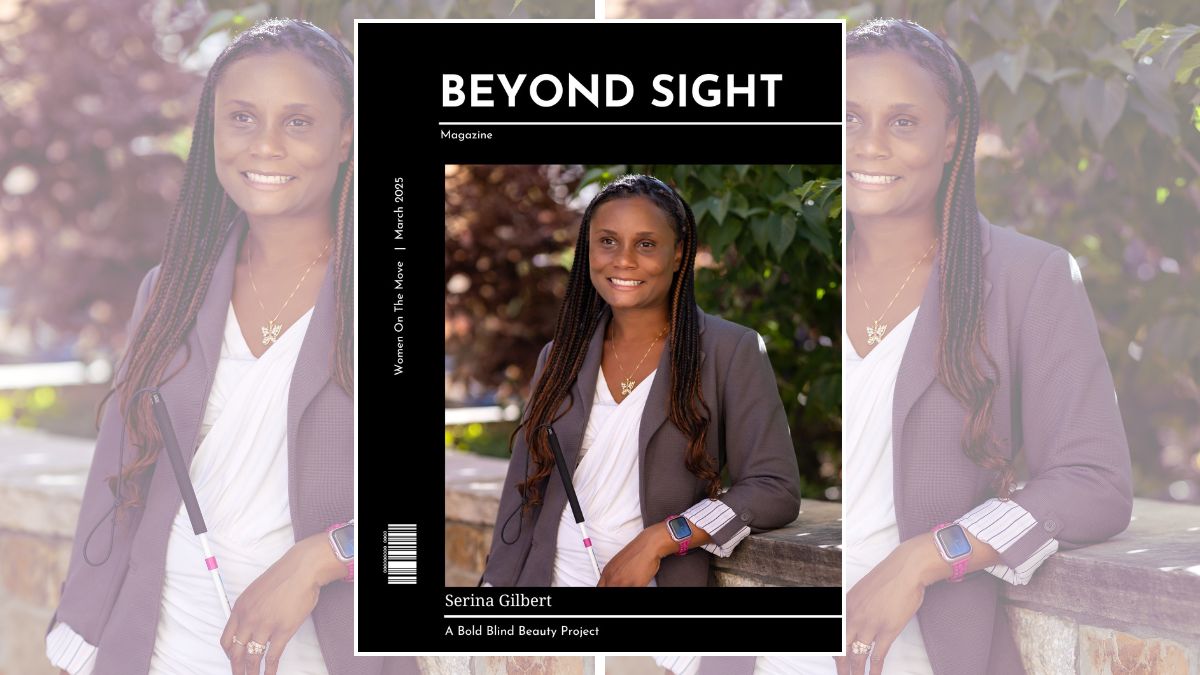
    The header photo is in the Beyond Sight Magazine cover template and shows Serina, a smiling woman with braided hair, standing outdoors, leaning against a stone wall. She is wearing a gray blazer, white blouse, and black pants. She holds a white cane with pink sections in her right hand. Her left hand rests on the wall, displaying a smartwatch with a pink strap and a ring. The background features green foliage, creating a serene atmosphere. The image is styled as a magazine cover with the title ‘BEYOND SIGHT | A Bold Blind Beauty Project’ and features ‘Serina Gilbert.’ The cover is dated March 2025.

    Being a mom is just awesome. It’s up and down, like, there’s hard times, you know, because being a parent is the hardest thing that
    you will ever do.

    ~Serina Gilbert

    Editor’s Note

    Bold Blind Beauty is delighted to feature Serina Gilbert as our March Woman On The Move! As you’ll see in her video below, Serina’s journey with retinitis pigmentosa (RP) began in childhood and has shaped her into a dynamic advocate, a dedicated professional, and a loving mother.

    She shares her experiences navigating sight loss, embracing mobility aids, and empowering others. Serina openly discusses how she felt about using a white cane and how she overcame it to embrace independence.

    Today, Serina works for the state of Colorado, empowering young adults with disabilities to achieve their goals. She’s also a self-described “audio description snob,” ensuring accessibility through quality control. As a mother to a middle-schooler, Serina balances her career with family life, approaching every challenge with humor and resilience.

    Serina’s story highlights the power of adaptability and the importance of embracing one’s unique journey, as showcased in her “Beyond Sight Magazine” cover feature and empowering video. Watch the video or read the transcript below to explore Serina’s experiences and insights. You can also connect with her on Facebook at Blindy Girl and on Instagram @BlindyGirlOfficial.

    Stephanae McCoy
    Editor-in-Chief, Bold Blind Beauty

    Beyond Sight Magazine Cover

    The Beyond Sight Magazine cover template and shows Serina, a smiling woman with braided hair, standing outdoors, leaning against a stone wall. She is wearing a gray blazer, white blouse, and black pants. She holds a white cane with pink sections in her right hand. Her left hand rests on the wall, displaying a smartwatch with a pink strap and a ring. The background features green foliage, creating a serene atmosphere. The image is styled as a magazine cover with the title ‘BEYOND SIGHT | A Bold Blind Beauty Project’ and features ‘Serina Gilbert.’ The cover is dated March 2025.
    Beyond Sight Magazine | Serina Gilbert

    YouTube Video

    Serina Gilbert | March Woman On The Move

    Introduction and Sight Loss Journey

    My name is Serina Gilbert, and I am super excited to be featured on Bold Blind Beauty for this month’s Women on the Move segment. I’m going to share a little bit about my vision loss journey, and then also give you some insight into where I’m at now. You might have recognized me from last month’s feature, as well as on social media as Blindy Girl.

    Early Life and Diagnosis

    A photo of Serina sitting on stairs. Her legs are crossed and she is wearing a peach-colored v-neck sweater paired with an iridescent heart-shaped necklace with a key beside it. She is smiling. 
    Serina On Stairs

    But to start with my vision loss journey, it started actually when I was very, very young. I was born with my eyes crossed and had to have surgery to have that corrected. I’ve always had some difficulty with my vision, but I didn’t receive an official diagnosis until I was about 13 or 14, so in 8th grade in middle school, of retinitis pigmentosa (RP).

    For those that are not familiar, retinitis pigmentosa is a degenerative eye condition that impacts one’s peripheral. So, kind of what’s on the outside of your eyes, like when you look out of the corner of your eye, vision, as well as vision acuity. So, I have a lot of difficulty seeing things that are to my left or my right. And also things are quite blurry for me. 

    I’ve been diagnosed with, I guess they would say object perception. It used to be light perception. Used to be even better than that in high school. But, retinitis pigmentosa also impacts your vision acuity, and then also for me, it especially impacts me when I’m in low-light settings and unable to see great contrast. So when it’s dark outside, I have significant night blindness or if I come from a bright space to a dark space, it’s hard for my eyes to transition and it takes a little bit of time. 

    When I was younger, I was always treated just like any of the other children. I was never made to feel that I couldn’t do anything or try anything. There were never any limitations put on me. I wanted to be viewed as quote unquote normal, even if that meant sometimes accidentally running into brick walls when I would go visit friends, you know, eh. It’s hard when you’re younger.

    Challenges and Adaptations in Education

    I started to have a little bit more difficulty when I was later in my high school career, and then especially college. So in high school I had an individualized education program, much like any other students that have disabilities that allowed for me to have accommodations, like having things written on the board, not in the colors like blue or green or red, because those were harder colors for me to see. My acuity back then was a lot better. I was able to read regular print. It took me a little bit longer, but I was still able to read regular print. I didn’t use any screen readers or a white cane or anything like that. 

    Transition to college, though, and the workload got a little bit heavier. And required a lot more reading and a lot more responsibility than just sitting in class and kind of absorbing the information.

    Transition to Independence

    So that’s when I started receiving some pretty intense services from my local vocational rehabilitation here in Colorado. And that helped me develop a lot of what’s called daily living skills. So learning to cook and clean adaptively. As well as orientation and mobility skills. So using a white cane safely, crossing a busy street safely. Making sure that I can travel independently on buses, paratransit, or whatever I choose.

    Now, I’m not going to say that learning to use the white cane was an easy transition for me. I was 19 or 20 years old when I started learning how to use the white cane, and very much so thought there was some stigma attached to using a white cane. Took me a long time to start using it and feel comfortable having it in public, more so or even around my co-workers. That’s pretty common amongst individuals that have vision loss, especially when it’s progressive.

    There is an adjustment period that has to kind of go through its, I guess, just kind of go through it to get there. To have that level of acceptance of this white cane as a mobility device, it’s something that actually can help me, not hinder me, and it’s nothing to be embarrassed of. But again, I want to reiterate, everyone makes that adjustment on their terms. And in their own time. So, luckily I was able to overcome that and eventually start using it a lot more often, especially in work settings.

    And then eventually I did actually get a guide dog, his name was Weston. And I used him a ton when I started working in my professional life and going to different high schools and things like that. He was just the light of everything, whenever I would go to different places and everybody just adored him.

    Professional Life and Achievements

    A photo of Serina sitting in her black office chair. She is wearing an olive-colored crew-neck sweater top and a Shokz headset. Her open laptop is in front of her on her desk.
    Serina is in an office chair

    So where I am now is I work for the state of Colorado for my vocational rehabilitation agency. I started about 14 and a half years ago as a counselor, a vocational rehabilitation counselor working with young adults with disabilities. They are my favorite group to work with. I love working with young adults and teens to help them find their goals and realize their potential, and the ability that they have to be successful in their work. 

    After that, I promoted in my agency to be a program manager under our youth services team. So what I do right now is I help manage programs to help young adults with disabilities be able to access our services and to make sure our services are made widely available. And I have a great opportunity to do lots of creative and innovative things to make those services available and get creative. In my spare time, I also like to do audio description quality control. I am a self-described audio description snob.

    But audio description quality control consists of a blind QC er, as we call it, a blind quality control specialist taking the audio description script, which is the actual words written down that the narrator would say in between the dialogue that occurs on a title. And making sure that the script is recorded properly, that the narrator has not accidentally said a different word that’s in the script. Also checking that script for clarity, making sure that it makes sense with the scene, and then double-checking for mistakes. We are all human, and sometimes a different name is mentioned than was meant, and the quality control specialist’s job is to catch those errors.

    Personal Life and Hobbies

    I am also a mom. I have a son that is in middle school, and he is just one of my favorite humans. And being a mom is just awesome. It’s up and down, like, there’s hard times, you know, because being a parent is the hardest thing that you will ever do.

    But I remember when I found out I was having a baby and I was so, so scared. I was like, how am I gonna change my son’s diaper? That is just so hard, I don’t even know. And one of my sighted friends that had just had a baby said, Serina, when I change my son’s diaper, I almost always do it in the dark in the middle of the night, you’ll be fine. And honestly, from that moment on, I was fine. It’s just so funny, the different things that you worry about.

    I also use a ton of technology. I am a technology dork. Anytime there’s new things that come out, I love to try them out. I love to just test them. I especially am a big fan of artificial intelligence and learning all the different things that it can do, including recognizing videos or helping me check my makeup when I need to. I am the first person to try something new when it comes out, if I’m able to.

    Conclusion and Social Media

    So I appreciate you taking some time to hear a little bit about my vision loss journey and some of the things that I’m up to now. If you’d like to follow me, you can look me up on Facebook at blindy girl. That’s B-L-I-N-D-Y girl. And on Instagram, it’s Blindy Girl Official. So B-L-I-N-D-Y-G-I-R-L official. Thanks so much. And again, have the most blessed day.

    Serina Gilbert’s Bio

    Serina is a mom, full-time professional, freelancer, and lover of all things fashion and beauty. She lives in beautiful Colorado with her husband and pre-teen son and enjoys shopping, delicious food, and is a self-proclaimed “audio description snob”.

    Connecting With Serina Gilbert

    Connecting With Bold Blind Beauty

    Like what you’ve read and want to chat about it? Join us in the Bold Blind Beauty Facebook group.

    Image descriptions:

    • The header photo is in the Beyond Sight Magazine cover template and shows Serina, a smiling woman with braided hair, standing outdoors, leaning against a stone wall. She is wearing a gray blazer, white blouse, and black pants. She holds a white cane with pink sections in her right hand. Her left hand rests on the wall, displaying a smartwatch with a pink strap and a ring. The background features green foliage, creating a serene atmosphere. The image is styled as a magazine cover with the title ‘BEYOND SIGHT | A Bold Blind Beauty Project’ and features ‘Serina Gilbert.’ The cover is dated March 2025.
    • YouTube Video description: Serina is sitting in a black office chair against a tan background. She is wearing a sleeveless navy blue sweater dress and her braids are pulled back with a sparkly 3-tier crystal and gold headband.
    • Serina On Stairs: A photo of Serina sitting on stairs. Her legs are crossed and she is wearing a peach-colored v-neck sweater paired with an iridescent heart-shaped necklace with a key beside it. She is smiling. 
    • Office Chair: A photo of Serina sitting in her black office chair. She is wearing an olive-colored crew-neck sweater top and a Shokz headset. Her open laptop is in front of her on her desk.