
Being a mom is just awesome. It’s up and down, like, there’s hard times, you know, because being a parent is the hardest thing that
~Serina Gilbert
you will ever do.
Editor’s Note
Bold Blind Beauty is delighted to feature Serina Gilbert as our March Woman On The Move! As you’ll see in her video below, Serina’s journey with retinitis pigmentosa (RP) began in childhood and has shaped her into a dynamic advocate, a dedicated professional, and a loving mother.
She shares her experiences navigating sight loss, embracing mobility aids, and empowering others. Serina openly discusses how she felt about using a white cane and how she overcame it to embrace independence.
Today, Serina works for the state of Colorado, empowering young adults with disabilities to achieve their goals. She’s also a self-described “audio description snob,” ensuring accessibility through quality control. As a mother to a middle-schooler, Serina balances her career with family life, approaching every challenge with humor and resilience.
Serina’s story highlights the power of adaptability and the importance of embracing one’s unique journey, as showcased in her “Beyond Sight Magazine” cover feature and empowering video. Watch the video or read the transcript below to explore Serina’s experiences and insights. You can also connect with her on Facebook at Blindy Girl and on Instagram @BlindyGirlOfficial.
Stephanae McCoy
Editor-in-Chief, Bold Blind Beauty
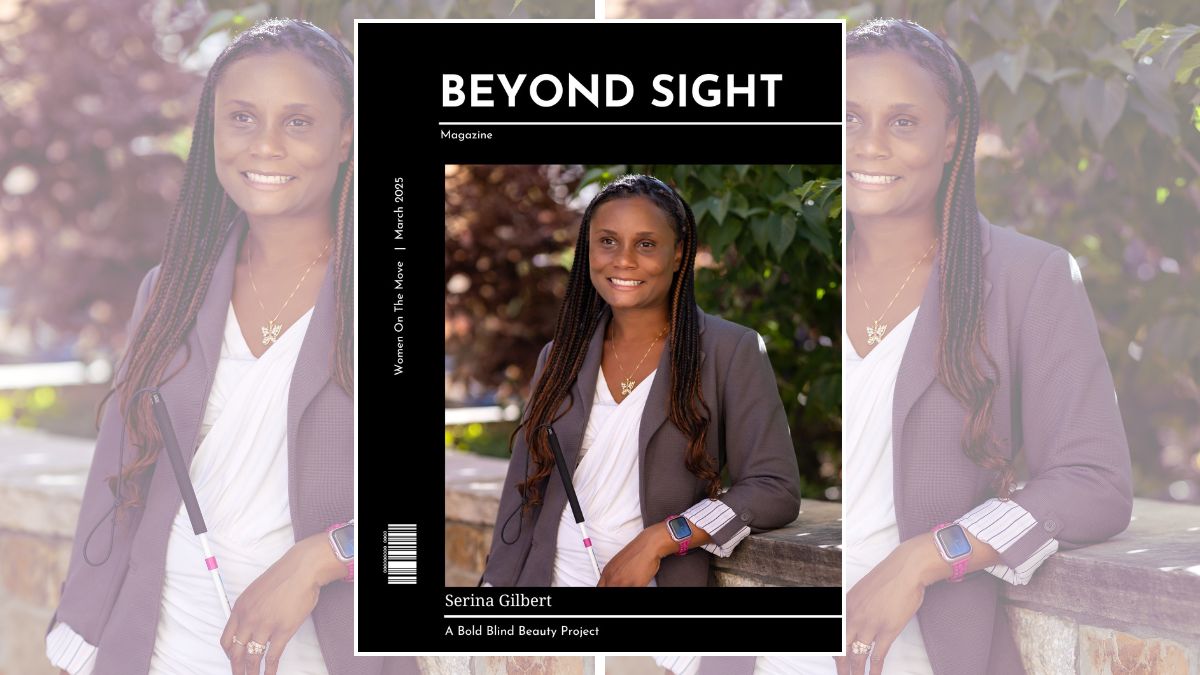
Beyond Sight Magazine Cover

YouTube Video
Introduction and Sight Loss Journey
My name is Serina Gilbert, and I am super excited to be featured on Bold Blind Beauty for this month’s Women on the Move segment. I’m going to share a little bit about my vision loss journey, and then also give you some insight into where I’m at now. You might have recognized me from last month’s feature, as well as on social media as Blindy Girl.
Early Life and Diagnosis

But to start with my vision loss journey, it started actually when I was very, very young. I was born with my eyes crossed and had to have surgery to have that corrected. I’ve always had some difficulty with my vision, but I didn’t receive an official diagnosis until I was about 13 or 14, so in 8th grade in middle school, of retinitis pigmentosa (RP).
For those that are not familiar, retinitis pigmentosa is a degenerative eye condition that impacts one’s peripheral. So, kind of what’s on the outside of your eyes, like when you look out of the corner of your eye, vision, as well as vision acuity. So, I have a lot of difficulty seeing things that are to my left or my right. And also things are quite blurry for me.
I’ve been diagnosed with, I guess they would say object perception. It used to be light perception. Used to be even better than that in high school. But, retinitis pigmentosa also impacts your vision acuity, and then also for me, it especially impacts me when I’m in low-light settings and unable to see great contrast. So when it’s dark outside, I have significant night blindness or if I come from a bright space to a dark space, it’s hard for my eyes to transition and it takes a little bit of time.
When I was younger, I was always treated just like any of the other children. I was never made to feel that I couldn’t do anything or try anything. There were never any limitations put on me. I wanted to be viewed as quote unquote normal, even if that meant sometimes accidentally running into brick walls when I would go visit friends, you know, eh. It’s hard when you’re younger.
Challenges and Adaptations in Education
I started to have a little bit more difficulty when I was later in my high school career, and then especially college. So in high school I had an individualized education program, much like any other students that have disabilities that allowed for me to have accommodations, like having things written on the board, not in the colors like blue or green or red, because those were harder colors for me to see. My acuity back then was a lot better. I was able to read regular print. It took me a little bit longer, but I was still able to read regular print. I didn’t use any screen readers or a white cane or anything like that.
Transition to college, though, and the workload got a little bit heavier. And required a lot more reading and a lot more responsibility than just sitting in class and kind of absorbing the information.
Transition to Independence
So that’s when I started receiving some pretty intense services from my local vocational rehabilitation here in Colorado. And that helped me develop a lot of what’s called daily living skills. So learning to cook and clean adaptively. As well as orientation and mobility skills. So using a white cane safely, crossing a busy street safely. Making sure that I can travel independently on buses, paratransit, or whatever I choose.
Now, I’m not going to say that learning to use the white cane was an easy transition for me. I was 19 or 20 years old when I started learning how to use the white cane, and very much so thought there was some stigma attached to using a white cane. Took me a long time to start using it and feel comfortable having it in public, more so or even around my co-workers. That’s pretty common amongst individuals that have vision loss, especially when it’s progressive.
There is an adjustment period that has to kind of go through its, I guess, just kind of go through it to get there. To have that level of acceptance of this white cane as a mobility device, it’s something that actually can help me, not hinder me, and it’s nothing to be embarrassed of. But again, I want to reiterate, everyone makes that adjustment on their terms. And in their own time. So, luckily I was able to overcome that and eventually start using it a lot more often, especially in work settings.
And then eventually I did actually get a guide dog, his name was Weston. And I used him a ton when I started working in my professional life and going to different high schools and things like that. He was just the light of everything, whenever I would go to different places and everybody just adored him.
Professional Life and Achievements

So where I am now is I work for the state of Colorado for my vocational rehabilitation agency. I started about 14 and a half years ago as a counselor, a vocational rehabilitation counselor working with young adults with disabilities. They are my favorite group to work with. I love working with young adults and teens to help them find their goals and realize their potential, and the ability that they have to be successful in their work.
After that, I promoted in my agency to be a program manager under our youth services team. So what I do right now is I help manage programs to help young adults with disabilities be able to access our services and to make sure our services are made widely available. And I have a great opportunity to do lots of creative and innovative things to make those services available and get creative. In my spare time, I also like to do audio description quality control. I am a self-described audio description snob.
But audio description quality control consists of a blind QC er, as we call it, a blind quality control specialist taking the audio description script, which is the actual words written down that the narrator would say in between the dialogue that occurs on a title. And making sure that the script is recorded properly, that the narrator has not accidentally said a different word that’s in the script. Also checking that script for clarity, making sure that it makes sense with the scene, and then double-checking for mistakes. We are all human, and sometimes a different name is mentioned than was meant, and the quality control specialist’s job is to catch those errors.
Personal Life and Hobbies
I am also a mom. I have a son that is in middle school, and he is just one of my favorite humans. And being a mom is just awesome. It’s up and down, like, there’s hard times, you know, because being a parent is the hardest thing that you will ever do.
But I remember when I found out I was having a baby and I was so, so scared. I was like, how am I gonna change my son’s diaper? That is just so hard, I don’t even know. And one of my sighted friends that had just had a baby said, Serina, when I change my son’s diaper, I almost always do it in the dark in the middle of the night, you’ll be fine. And honestly, from that moment on, I was fine. It’s just so funny, the different things that you worry about.
I also use a ton of technology. I am a technology dork. Anytime there’s new things that come out, I love to try them out. I love to just test them. I especially am a big fan of artificial intelligence and learning all the different things that it can do, including recognizing videos or helping me check my makeup when I need to. I am the first person to try something new when it comes out, if I’m able to.
Conclusion and Social Media
So I appreciate you taking some time to hear a little bit about my vision loss journey and some of the things that I’m up to now. If you’d like to follow me, you can look me up on Facebook at blindy girl. That’s B-L-I-N-D-Y girl. And on Instagram, it’s Blindy Girl Official. So B-L-I-N-D-Y-G-I-R-L official. Thanks so much. And again, have the most blessed day.
Serina Gilbert’s Bio
Serina is a mom, full-time professional, freelancer, and lover of all things fashion and beauty. She lives in beautiful Colorado with her husband and pre-teen son and enjoys shopping, delicious food, and is a self-proclaimed “audio description snob”.
Connecting With Serina Gilbert
- Facebook: Blindy Girl (facebook.com/blindygirl)
- Instagram: @BlindyGirlOfficial (https://www.instagram.com/blindygirlofficial)
Connecting With Bold Blind Beauty
Like what you’ve read and want to chat about it? Join us in the Bold Blind Beauty Facebook group.
Image descriptions:
- The header photo is in the Beyond Sight Magazine cover template and shows Serina, a smiling woman with braided hair, standing outdoors, leaning against a stone wall. She is wearing a gray blazer, white blouse, and black pants. She holds a white cane with pink sections in her right hand. Her left hand rests on the wall, displaying a smartwatch with a pink strap and a ring. The background features green foliage, creating a serene atmosphere. The image is styled as a magazine cover with the title ‘BEYOND SIGHT | A Bold Blind Beauty Project’ and features ‘Serina Gilbert.’ The cover is dated March 2025.
- YouTube Video description: Serina is sitting in a black office chair against a tan background. She is wearing a sleeveless navy blue sweater dress and her braids are pulled back with a sparkly 3-tier crystal and gold headband.
- Serina On Stairs: A photo of Serina sitting on stairs. Her legs are crossed and she is wearing a peach-colored v-neck sweater paired with an iridescent heart-shaped necklace with a key beside it. She is smiling.
- Office Chair: A photo of Serina sitting in her black office chair. She is wearing an olive-colored crew-neck sweater top and a Shokz headset. Her open laptop is in front of her on her desk.