I believe that no matter how much more my vision will degenerate, I now have the trust in myself and the trust in my surroundings that I will be able to thrive in the future.
~Marie Elise | @beyondmyblur
Editor’s Note
With great pride, we spotlight Marie Elise as Bold Blind Beauty’s May Woman On The Move. Previously featured as our April Monthly Beauty, Marie Elise’s story is proof of the transformative power of advocacy, leadership, and lived experience in the disability community.
Through her immersive travel stories, Marie Elise invites us to experience the world beyond sight-capturing the sounds, scents, textures, and flavors of natural destinations. Her unique perspective inspires us to connect deeply with our surroundings and discover the richness of every place through all our senses.
Building on this, Marie Elise’s work demonstrates that advancing equity isn’t just about breaking down barriers, it’s about expanding what’s possible when we center diverse perspectives and lived experiences. Her dedication to authentic representation and her ability to inspire meaningful change shine as a guiding light for all striving to create a more inclusive world.
We are honored to share Marie Elise’s story and celebrate her impactful contributions to disability advocacy and beyond.
Stephanae McCoy
Editor-in-Chief, Bold Blind Beauty
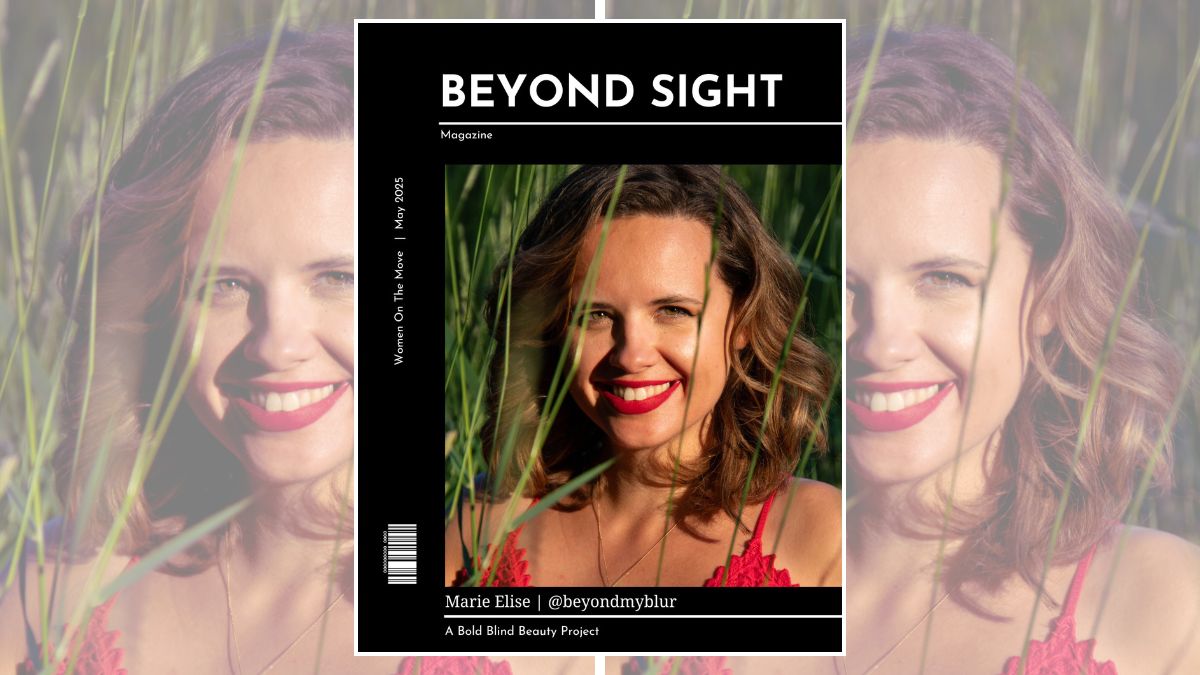
Beyond Sight Magazine Cover

YouTube Video
Introduction and Gratitude
Hi everyone. Thank you so much for tuning in to this video. I am just beyond grateful and excited to be featured in this month’s segment of Women on the Move from Bold Blind Beauty, and will be sharing a bit more about my vision loss journey in this video. My name is Maria Elise. I’m 32 years old and I was born and raised in the Netherlands, which is also where I currently live.
I was diagnosed with Stargardt’s Disease, which is a subtype of juvenile macular degeneration, the genetic form of macular degeneration, when I was about 16 years old. This is, I think, about the average age to be diagnosed with Stargardt’s disease. The onset of the disease can vary a lot; some are diagnosed younger, already in their childhood, some, like me, uh, in puberty, and others, even in early adulthood.
Living with Stargardt’s Disease

Because of this condition, I am losing the central portion of my vision. So in the central part of my vision, I basically see a constantly moving blur with sort of like, I think it’s called visual noise in it. This kind of blur in the middle can get gray or black in the future, but I do not know when or how fast that is going to happen.
For me, my sight loss was quite rapid in the beginning. I think that I already started losing vision when I was maybe around 12 or 13, I just didn’t notice it. It’s because when I was diagnosed, I saw about 50% in my left eye and 30% in my right eye. Even though probably many of you with visual impairment will know that it is very difficult to sort of express what you see in percentages because my vision really varies depending on the lighting conditions, on how much color contrast there is, et cetera, et cetera.
Now I see between 10% to 15%, more or less, again, depending on the day. But I’ve had the luck that for at least the past couple of years, my vision has been relatively stable. So right now, I find myself in a phase where it’s stagnated.
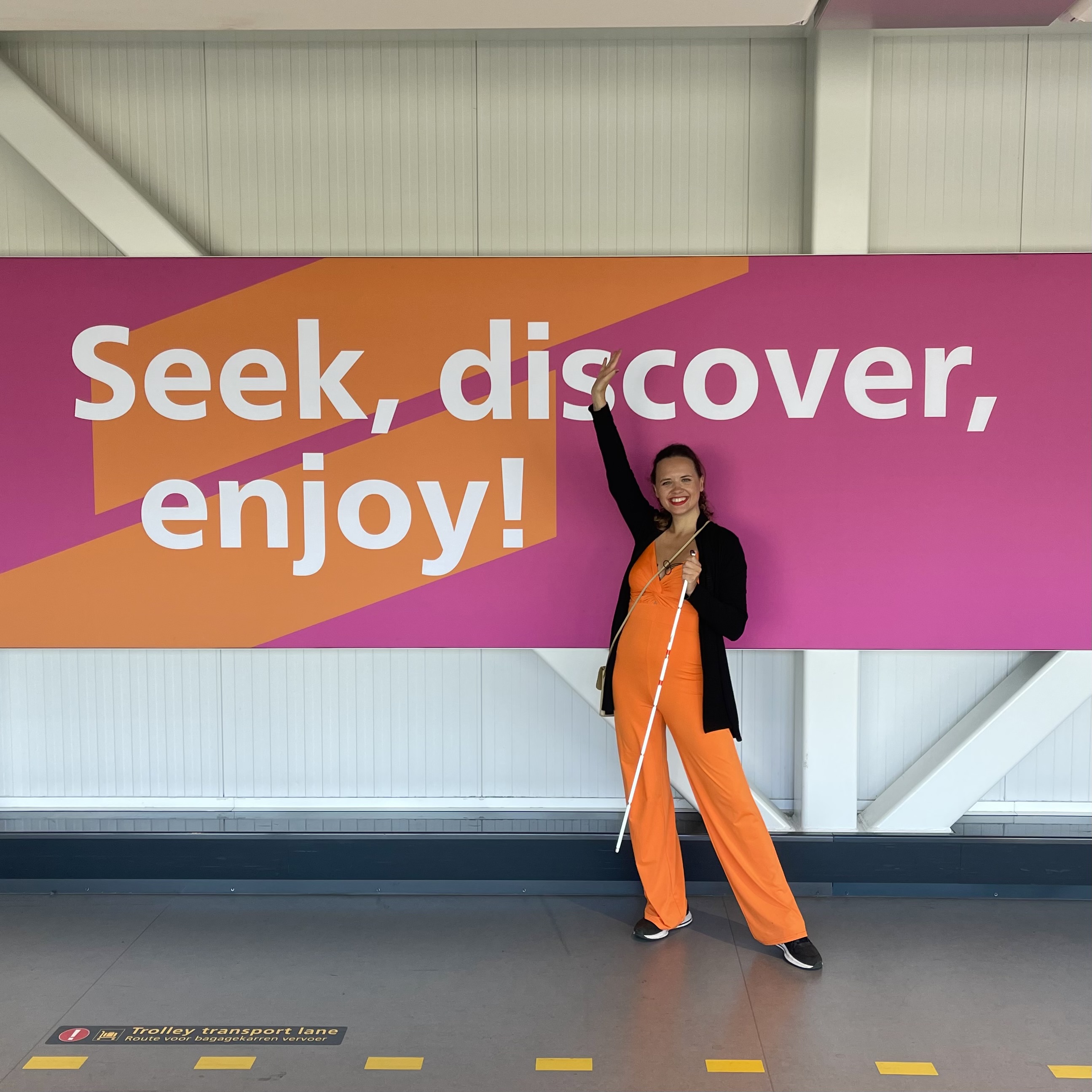
My current vision allows me to navigate the streets without a white cane, as I still have enough functional vision left. But I do use an ID cane or symbol cane, especially when I’m traveling, to communicate to those around me that I have a visual impairment.
Coping with Anxiety and Building Trust
In the beginning, when I first got diagnosed, of course, I was still quite young that my brain took, as I like to call it, the dirtiest yet quickest escape route for me, which was flight.
I think that I suppressed my emotions concerning my visual condition for many years. I think that subconsciously, I was deeply anxious and truly afraid of what was going to happen to me in the future. And part of me still is, except now I have acknowledged that I have this anxiety. I have worked with it, and I have also grown a very steady and high level of trust for the future. As I really believe that no matter how much my vision will degenerate, I now have the trust in myself and the trust in my surroundings that I will be able to thrive in the future. And this doesn’t mean that the anxiety has gone away completely, but it just means that it is something that I can control and no longer overtake my life.
Because, unfortunately, when I was about 24 years old, having suppressed emotions for so many years, I suffered an anxiety disorder, and was in a really bad, bad place for the second half of my twenties. And I think this was my body’s way of saying, like, Hey, you know, I think that you’ve been suppressing a lot of emotions concerning your insecure future. And it’s time to, well, kind of look at it in the mirror, and that’s what I did. And here I am, in a place of more trust and love towards myself. So that was also really important for me to share with you in this video.
Creating a Travel Platform

I think part of where the trust comes from is also that I now have my own platform. I am a very passionate traveler. I have always been, since I was a young child, I watched a lot of Steve Irwin, and I loved Planet Earth and listening to David Attenborough, and all the nature documentaries. I’ve always been crazy about exploring. But of course, when you get told that you’re losing a very important part of your vision, I think there was also a part of me that was, that was really afraid that I could no longer do something that I was so passionate about.
So, being a passionate traveler, I actually started a travel platform for visually impaired travelers that is specifically, but not exclusively, as I like to say, for visually impaired travelers. And I share stories there about everything that I experience on my travels non visually. So I write about sounds and smells and textures and flavors. And I also report on accessibility insights from the destinations that I visit, as unfortunately, accessibility still varies from destination to destination.
So I just hope that this is a very inclusive travel media source for all of you watching that also like traveling like me, but are not really sure where to find the right information. With this platform, of course, I hope to motivate visually impaired travelers to keep on exploring. I hope to push for a more inclusive travel industry. But I also really hope that it will just inspire people, regardless of visual ability, to consciously connect with their senses and to just be with their environment in a richer way. As many of us depend so much on our vision that I think we forget just how powerful our smell is and how powerful our ears are, et cetera, et cetera. So that is really something that I hope my stories can do.
Passions Beyond Vision

Another part of I think, where my newly developed self-trust comes from is that I have really learned that my visual disability is just a tiny part of who I am. For example, I also really love makeup. I’m wearing red lipstick right now, which I almost wear every day.
I really love animals, I’m crazy about dogs. I’ve had two already in my life, and hopefully next year, I’ll get my third dog. I love horse riding, I just love the feeling of being in the saddle. You know, as competent horse riding is very much about becoming in sync with the movement and the feeling with the horse.
I love teaching. Aside from riding and creating for my platform, I also earn my money as a teacher. I am a private tutor for children. Uh, so I’m very passionate about educating people, which is something that I do on my platform, too, of course. I love baking. I love the feeling of kneading dough. I’m a very smell and touch-oriented person, partly due to my visual disability, of course, but just also because I find that really relaxing.
What I would also like to add is that I am very passionate about South American culture. I have lived in both Spain and Argentina, so Dám Español. I love the warmth of the people there. I love their passion for dance and food. It’s quite different from the country where I’m from, which is in the north of Europe. So it’s a continent that I love traveling to. Also, because I feel safer traveling to countries where I can speak the local language, so that if I need any help, well that I can ask for help from the locals in their language.
Connecting with Me
So if you have any questions for me, of course, feel free to drop them in the comments. You can also send me a DM via my Instagram @beyondmyblur. You can write me an email, which is beyondmyblur@gmail.com. And of course, you can visit my travel website and maybe sign up for the newsletter so you can stay tuned for updates, which is www.beyondmyblur.com.
And then I want to thank you for watching, and I want to wish you a great rest of your day.
Marie Elise’s Bio
Marie Elise (32) is a travel writer, speaker, and content creator from the
Netherlands. At the age of 16, she was diagnosed with Stargardt’s disease, a
condition that causes progressive loss of central vision. A passionate explorer,
she founded Beyond My Blur, a platform for visually impaired travelers. On her
website and social media, Marie Elise shares non-visual travel stories – rich in
sounds, scents, textures, and flavors – alongside accessibility insights for each
destination. Through her work, she aims to inspire people of all visual abilities
to consciously connect with their senses and push for a more inclusive travel
industry.
Connecting With Marie Elise
- 📩 beyondmyblur@gmail.com
- 🌐 www.beyondmyblur.com
- 📲@beyondmyblur (Instagram/TikTok)
- 🌎 Marie Elise Aarts (LinkedIn)
Connecting With Bold Blind Beauty
Like what you’ve read and want to chat about it? Join us in the Bold Blind Beauty Facebook group.
Image descriptions:
- The header photo is in the Beyond Sight Magazine cover template and shows a portrait of Marie Elise. She has wavy, shoulder-length brown hair and is
smiling brightly while sitting among tall green grass. She is wearing a vibrant
red lace top with thin straps and a delicate gold necklace featuring a small
charm. The sunlight casts a warm, golden glow on her face, highlighting her
skin, red lipstick, and cheerful expression. Some blades of grass are in the
foreground, slightly blurred, adding a natural and intimate atmosphere to the
image. The image is styled as a magazine cover with the title ‘BEYOND SIGHT | A Bold Blind Beauty Project’ and features ‘Marie Elise | @beyondmyblur.’ The cover is dated May 2025. - Piccybot YouTube Video description: Marie Elise is smiling and engaging directly with us. Her skin is pale, with her cheeks lightly flushed, and she’s wearing striking red lipstick. Her eye makeup is subtle but enhances her almond-shaped eyes.
- Her brown hair, with some lighter highlights, is parted slightly off-center and is styled in a neat side braid that cascades over her left shoulder. On the left side of her hair, near her forehead, she sports a vibrant red flower. She’s wearing a dark, button-down shirt adorned with a floral print; the flowers seem to be pink, red, and possibly a touch of white. A delicate silver necklace is visible around her neck.
- She seems to be in what looks like a cozy living room. Behind her, we see a large, rectangular window with a split frame, suggesting it might open in two halves. The window is covered with a white curtain bearing a floral pattern that includes birds, leaves, and flowers. To the right, there’s a tall, dark wood cabinet with ornate carvings, and to the left, we catch a glimpse of what seems to be the back of a pink armchair. On the table just underneath the window, there is a beautiful sculpture of an egret. To the left on the same table is a decorative vase. There is a dark green pillow with a leaf print pattern placed beside the sculpture.
- Marie Elise riding a white horse: Marie Elise is riding a white horse along a sandy beach with gentle waves rolling in behind her. She is smiling and wearing a riding helmet, dark
sunglasses, and a patterned black-and-white long-sleeve top with dark riding
pants. The sky is a vibrant mix of blue and white, filled with soft, wispy clouds.
The overall scene is bright, open, and joyful, capturing a serene moment by the
sea. - The Mona Lisa: Marie Elise, wearing a black polka dot dress and holding her symbol cane in her left hand, is smiling in front of the Mona Lisa painting in the Louvre. The only
thing separating her and the painting is an oval-shaped wooden bar. She is
standing in the designated disability space in front of the Mona Lisa. - ‘The World Unseen’: Marie Elise, sitting down with her symbol cane in her hand, and standing on the ground, is touching a series of tactile photos at ‘The World Unseen’
exposition by CANON. She looks concentrated as her fingers are resting on the
images that show hands of elderly people, made tactically by textured prints of
the photos.