I have some visual acuity so I don’t act like what people perceive as blind or visually impaired, and with a dominant perception of blindness being absolute, it makes sense that people are skeptical when they witness me navigating crowded spaces with my white cane in hand.
~Bill Porter
Editor’s Note
It is my pleasure to introduce Bill Porter as Bold Blind Beauty’s May Man In Motion. I had the privilege of meeting Bill during our ASPECT advocacy cohort last fall, where his candor, creativity, and commitment to challenging perceptions of blindness left a lasting impression on me and our peers.
Bill’s story, “Rethinking Blindness: Bill Porter’s Perspective,” is a powerful reflection on navigating life with retinitis pigmentosa, an inherited retinal disorder that causes progressive vision loss. From his early experiences with night blindness in childhood to the pivotal moment when a medical expert told him to give up on his dreams, Bill’s journey is marked by resilience, self-discovery, and a refusal to let others define his potential.
What stands out most about Bill is his willingness to confront internalized ableism and societal misconceptions head-on. Through his work as a professional artist, educator, and advocate, he not only reclaims his narrative but also sparks important conversations about disability identity, authenticity, and the diversity of lived experiences within the blindness community.
Meeting Bill through the ASPECT Program’s Prevent Blindness initiative, designed to empower advocates through storytelling, support, and training-underscored the importance of amplifying voices like his. Bill’s journey reminds us that true inclusion requires questioning outdated narratives and making space for every individual to define their path.
We are honored to share Bill’s perspective, celebrate his ongoing impact as a Man In Motion, and invite you to watch his video or read the transcript below.
Stephanae McCoy
Editor-in-Chief, Bold Blind Beauty
Beyond Sight Magazine Cover

YouTube Video
Introduction: Embracing the Unexpected Path
Hello. It is an honor and a privilege to be speaking with you today. My name is Bill Porter. I have an inherited retinal disorder called retinitis pigmentosa, which causes progressive vision loss.
When I was in elementary school, I discovered I couldn’t see in low light, and I immediately knew I had the same blindness causing disease as my mother. It was terrifying and it was embarrassing. My childhood activities were strenuous, like being in movie theaters or any outdoor activities after sunset. I would bump into things and crash into objects or people, and balls I was catching earlier in the day were all of a sudden bouncing off my face.
I tried to explain to people I had a rare eye condition that caused night blindness, but nobody really understood. I got questions like, well, if you’re really visually impaired, why don’t you wear glasses? The feedback I received, even from my own mother, was that it was just best to hide it, play the clown, and endure the laughter and the shame.
A Pivotal Diagnosis and Defiant Ambition

When I was 18, I saw an optometrist who was a leading expert in my retinal disease. I naively went to the appointment expecting to receive empathy and support, and encouragement, but it was quite the opposite. The doctor told me to give up on my dreams of being an artist. He told me not to waste my time with a college education, and he told me that my only chance for a meaningful life was to support his research and hope for a cure.
I was driven to pursue my passions, and I used the doctor’s words as motivation. I went on to earn a BFA and an MFA and have had a successful career as a professional artist and educator.
Despite my determination for most of my life, I avoided coming to terms with my disability, though. This includes staying away from vision specialists, avoiding any thoughts or discussions about visual impairments. I was afraid to face how my progressive vision loss would impair my future, that is, until it became unavoidable. Awkward moments in public began to mount. I was considered rude for not shaking someone’s hand that I didn’t see, and I would bump into people who cut me off in crowded public spaces. It was clear that trying to hide my disability was creating problematic misunderstandings, and it was time to be open about my low vision.
Acceptance and Advocacy: A Turning Point

I stopped driving. I sought medical care from a low vision optometrist who respected me as a human. And in 2018, I was diagnosed as legally blind.
These events were difficult to face, but it was a blessing as it forced me to come to terms with my narrowing sight, which led to a broadening perspective about my disabled self-concept. My long-held, I don’t want to know attitude turned into an ever-growing curiosity about disability, identity, culture, and how I could be an advocate. I learned about ableism and how deeply embedded it is in all aspects of society. I began to unpack the discourse I had heard about vision loss throughout my life and how I internalized all those ableist views. I started using a white cane in public spaces because of the potential to help me both navigate, more importantly, its ability to help serve as a visual cue to others that I was visually disabled.
But unfortunately, my magic wand is no match for the kryptonite that is our unaware and ableist culture. The misguided perception of blindness is absolute, and many people are skeptical of individuals who identify as disabled, as they think they could be faking it, which is one of the many symptoms of our culture’s misrepresentation of blindness.
As a result, I’m constantly at odds with myself about when I should use my cane. It both helps me avoid conflict and gets me into it. I’ve been grabbed without warning and dragged away from where I need to go. People have showered me with pity and offered to pray for me to be cured. If I hold my cane, I feel like I have to act blind, by not reading signs, looking at my phone, or making eye contact with people. ‘Cause if I do, I run the risk of someone shouting “he’s a faker,” and yes, that’s happened to me. I’m in a difficult spot, just like other people I’ve spoken to from the low vision community.
How do I identify myself? How do I engage in a world that doesn’t believe someone like me exists? As I’ve covered, not disclosing and leaving my mobility aids at home as an effort to avoid attention doesn’t work. Going to the other extreme and acting the part of being blind doesn’t work either. It’s just really uncomfortable.
Choosing Authenticity Over Expectation

So, you know, I decided I just need to be true to myself and do what’s best for me, regardless of the situation and how uncomfortable it is, or how much undesirable attention it’ll provoke. I came to this conclusion when I realized how much I was internalizing ableism. I worried way too much about what other people thought to the point of projecting judgment.
Under the circumstances, it makes sense why it’s uncomfortable navigating the world, and my fear of judgment is based on decades of experiencing it. I call it out, but I also understand why it happens. I have some visual acuity so I don’t act like what people perceive as blind or visually impaired, and with a dominant perception of blindness being absolute, it makes sense that people are skeptical when they witness me navigating crowded spaces with my white cane in hand, and then I’ll fold it up and walk without it. That is confusing.
Being a visual artist and a studio art professor who is legally blind is also a foreign concept to most people. The fact is that’s my reality. I choose not to let judgment fueled by antiquated or inaccurate social definitions of blindness alter who I am or how I present myself. It is definitely not easy, but I now know that when I do what I feel is best for me without any consideration of how it’ll be perceived, is the right way to go.
Conclusion: Living Boldly with Vision Loss
This means using my white cane when I feel it’s necessary and putting it away when it’s not. It means participating in activities that my limited vision allows me to, even when I’m in spaces where I’ve disclosed, I’m visually impaired. This also means using my platform as an artist and educator to be able to tell my story and hopefully change people’s perceptions on what blindness is and serve as a role model to others. In doing so, though I don’t want pity, I don’t wanna be considered exceptional, and I definitely don’t wanna be labeled as inspirational from my life’s achievements just because I have a disability.
What I do hope is to inspire a collective questioning about the narrative around visual disabilities, which includes a narrowing viewpoint about what blindness is and how the barriers our community faces are a construct fostered by a long history of systemic marginalization.
Bill Porter’s Bio
Bill Porter is a Boston-based visual artist and educator. He holds an MFA in Visual Arts, a BFA in Animation, and a Certificate in Film Studies. Bill teaches as an adjunct professor in the Integrated Studies and Animation departments at Lesley Art + Design in Cambridge, MA. His paintings, illustrations, and multimedia works have been exhibited and published throughout the United States, Europe, and South America. Through his practice, teaching, and public speaking, Bill shares his personal story and advocates for the disabled community.
Connecting With Bill
- Website: billaporter.com
- Instagram: @billaporter
- LinkedIn: billaporter
Join Our Community
Like what you’ve read and want to chat about it? Join us in the Bold Blind Beauty Facebook group.
Image Descriptions:
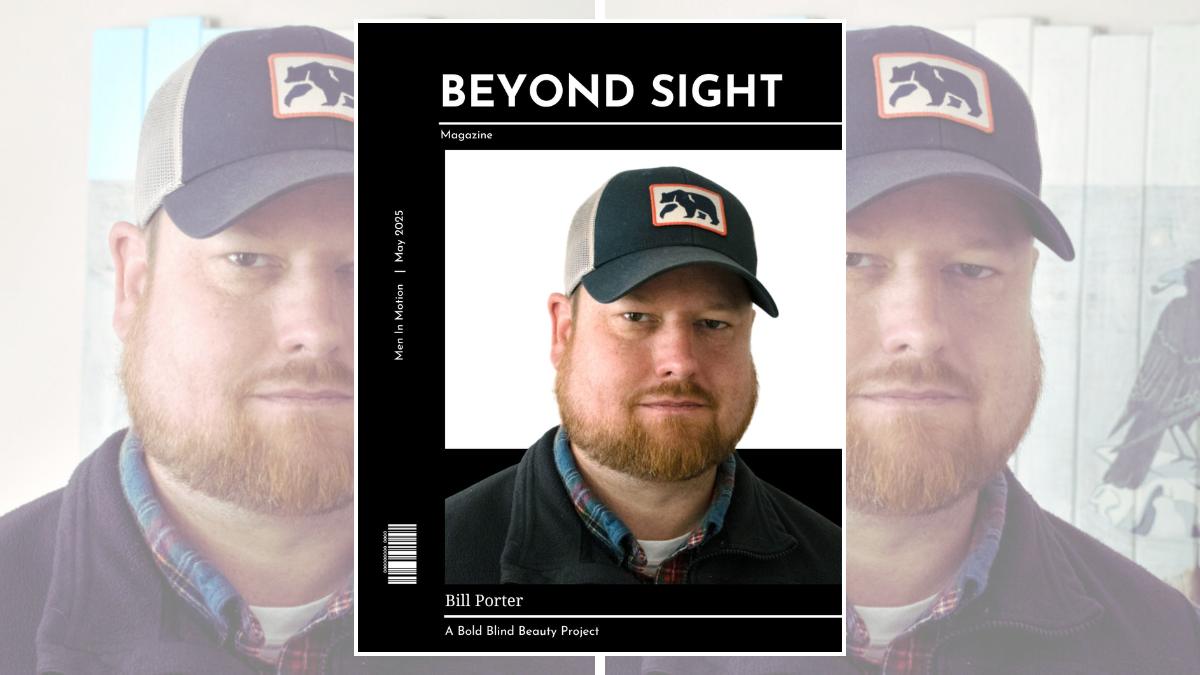
- The header, the Beyond Sight Magazine cover, and the YouTube Thumbnail include a headshot of Bill standing in front of one of his paintings. He is wearing a dark cap featuring a bear logo on the front. He has a light-colored beard and is dressed in a checkered shirt layered under a black vest. Behind him is a rustic wall decoration made from wooden planks, which features a painted bird. The image is styled as a magazine cover titled ‘BEYOND SIGHT | A Bold Blind Beauty Project’ and features ‘Bill Porter’. The cover is dated May 2025.
- YouTube Video Description: Bill is speaking directly to the camera; it’s a medium shot, framed from his chest up, in a brightly lit room that gives off a comfortable, lived-in vibe. He’s got a friendly face, a neatly trimmed reddish beard, and clear eyes. He’s wearing a colorful, multi-toned plaid flannel shirt, which adds a bit of a rustic touch. Topping off his look is a gray baseball cap with an emblem that appears to depict a bear.
- Behind him, we can see that he’s in a room with high ceilings and exposed wooden beams. To his left is a bookcase overflowing with books of various colors and sizes. There are also several framed artworks of different dimensions on the wall around the bookcase. Over to his right, we see two more pieces of artwork and a vibrant blue loveseat that looks inviting. There’s a desk in front of the bookcase, visible in the lower-left corner, with a lamp, tablet, and some other items on it. The overall impression is of a warm, creative, and organized space.
- Bill is sitting on a couch in his art studio, holding a white cane, with his light brown dog Theo sitting next to him. He’s wearing a dark long-sleeve shirt and blue jeans, holding a white cane with a red tip. The dog’s fur is soft, and it sits patiently, looking at the camera. A bright, colorful wall art piece is visible in the background, adding vibrancy to the scene.
- Bill’s painting titled Oblivious-sided. It includes red comic text “SPLAT!”. Below the text is a white splatter that looks like a snowball with action lines implying it was thrown. There is also a gray fedora hat, a white cane, and curved black action lines.
- A pair of Bill’s paintings on a wall. The title of the dyptich is Unforeseen Impact 001. One painting is at eye level with splattered paint in the background and text that reads “WHAM!”. The second painting is a yellow folding CAUTION Wet Floor sign, which is located directly below the other painting, close to the floor.